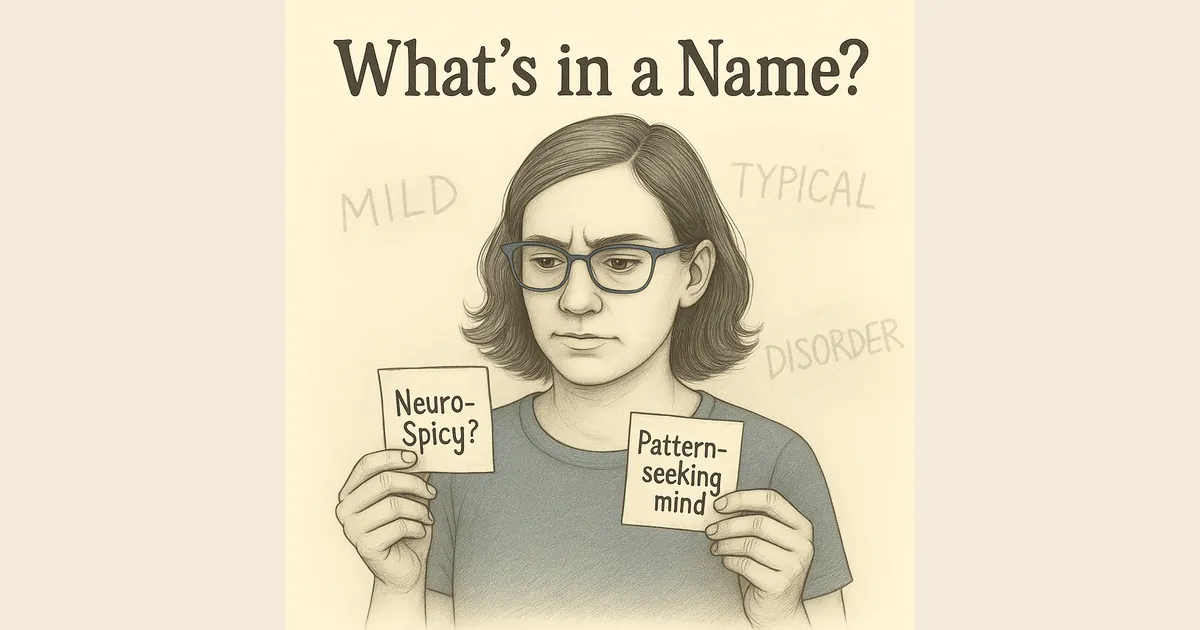
What’s in a Name? Why “Neuro-Spicy,” “Neurotypical,” and the Language of Difference Matter
Estimated reading time: 10 minutes
This article explores why neurodivergent language matters, because some labels help, some erase us, and some just try to be cute when what we really need is clarity, credibility, and change.
From Labels to Liberation
Playful language has its place. But only if it doesn’t dilute the need for real change.
Let’s drop the spicy metaphors and the typical traps. Stop masking to meet systems that never served us. Let’s name things in ways that open doors, not shut people out.
Neurodivergent people aren’t rare. Many of us are just unnamed. And we’re ready for something better.
1. When Cute Isn’t Enough
The term “neuro-spicy” started online as a cheeky way to describe neurodivergence. It made people smile. It softened the awkwardness. But softening is not always what we need.
In reality, neurodivergent people often live in environments that are fundamentally incompatible with how their brains work. What we need is clarity, not cuteness. Language that affirms, not diminishes. Terms that support us in reshaping systems, not just surviving inside them.
Framing ADHD or autism as spicy implies a mild-to-hot scale, as if these are just personality flavours, rather than neurotypes with significant social, emotional, and functional implications.
The term “neurospicy” began circulating more widely online around 2022–2023, especially on TikTok and Instagram, often used by self-identified neurodivergent creators. Its playfulness emerged in part as a rebellion against terms like “mild autism” or pathologised labels. But despite its solidarity and humour, it risks minimising the seriousness of daily systemic barriers. [1]
Playful language has its place, but only if it doesn’t dilute the need for real change.
(Explore a comprehensive overview of what it means to be neurodivergent if the term is still new to you.)
2. Our Environments Aren’t Built for Us
If we go back even further, before clocks, before screens, before modern schooling, it’s possible that neurodivergence made far less of an impact. There were no bell timetables or digital notifications to battle. Life had more repetitive cycles and shorter working hours. People with ADHD traits may have simply been seen as quick thinkers, crisis solvers, or intense personalities. Before smartphones, 24/7 work culture, and endless online choice, life had more rhythm. Less noise. Less pressure. And while modern life is overwhelming for everyone, it’s especially incompatible with the way many neurodivergent people process information, navigate time, and regulate energy.
Masking, adapting, shrinking ourselves to fit systems that don’t flex, this isn’t sustainable. For any of us.
3. The Trouble With “Neurotypical”
Even the term “neurotypical” is problematic. It implies there’s one standard type of brain, one baseline, and everything else is a deviation.
But the truth is: we don’t even know who’s neurotypical. Many people have had enough support, privilege, or structure to scaffold executive dysfunction without ever realising it. Others have masked so long they’ve internalised the act.
I probably wouldn’t have pursued an ADHD diagnosis if I hadn’t become a parent. I’d always felt offbeat, but I was great at managing systems. I unknowingly built scaffolding that masked how hard I was working just to function. It was only when that scaffolding crumbled under parenting demands that I saw the full picture.
There are so many of us living without answers, not because we aren’t neurodivergent, but because the language and access hasn’t reached us yet.
4. A Brief (and Honest) History of Neurotype Naming
|
Neurotype |
Historical Term(s) |
Modern Label |
Why It Served Then |
Why It May Not Serve Now |
|---|---|---|---|---|
|
ADHD |
Minimal Brain Dysfunction, ADD, Hyperkinesis |
ADHD (DSM-5) |
Fit medical frameworks, explain behaviour |
Implies deficit; medicalised; doesn’t reflect lived experience |
|
Autism |
Infantile psychosis, Kanner’s Syndrome |
Autism Spectrum Disorder (ASD) |
Created clinical clarity |
Misses strengths; spectrum misunderstood as linear |
|
Asperger’s |
Asperger’s Syndrome |
Removed; now ASD |
Differentiated traits without language delay |
Many lost diagnosis; now excluded |
|
Dyslexia |
Word-blindness |
Dyslexia |
Named specific struggle |
Still useful, non-comparative |
|
Dysgraphia |
Poor handwriting (informal) |
Dysgraphia |
Gave name to writing struggles |
Still niche; often misattributed |
|
Neurotypical |
Coined in 1990s (satirical) |
NT |
Helped define ND by contrast |
Implies one brain type is default |
|
Neuro-spicy |
Internet slang |
Casual ND descriptor |
Created humour and solidarity |
Trivialises challenges; implies scale or heat |
5. Diagnostic Shifts Don’t Make People Disappear
The DSM-5 eliminated Asperger’s Syndrome as a diagnosis. It folded it under Autism Spectrum Disorder. Some people lost their clinical identity entirely. Others were told they no longer met the threshold.
But nothing in their brains changed.
It showed us just how fragile these definitions are. Brains don’t change when diagnostic manuals do. Yet access to services, support, and self-understanding often does.
This shift disproportionately excluded women, BIPOC individuals, and late-diagnosed adults who were already on the margins.
We can’t build identity on systems that move the goalposts. We need frameworks that honour real experience.
6. When Language and Access Collide
My son showed signs of dysgraphia early. He could read well above his age but struggled to form letters on paper. Despite raising concerns with teachers, I wasn’t taken seriously until we had a formal educational assessment confirming it.
By that time, school refusal had escalated. It wasn’t just about handwriting anymore. We became unplanned homeschoolers. And while I’m deeply grateful we had that option, the impact has been real: on his wellbeing, yes, but also on my future career options, financial flexibility, and identity. Unicorn roles that accommodate caregiving realities are rare.
A diagnosis on paper shouldn’t be the only language schools understand. Yet without it, support is too often withheld.
7. Are We All “On the Spectrum”?
People sometimes say, “Aren’t we all on the spectrum?”
No, we’re not all on the autism spectrum. That’s a specific neurodevelopmental profile. But yes, we are all on a spectrum of something, social energy, focus, sensory tolerance. In plain English, the confusion is understandable. Before my own diagnosis, I also didn’t know what I didn’t know.
Some say it to dismiss. Others say it to relate. Some just haven’t found better language yet. So we clarify. Gently, when we can.
We don’t need everyone’s validation to move forward, only shared momentum with those willing to learn.
8. Cultural Pressure and the Invisible ND
In Japanese culture, “black companies” are known for extreme overwork. Some people, overwhelmed by impossible expectations, disappear rather than endure.
Night movers help individuals escape. While many flee abuse, others simply feel they don’t belong.
I wonder: how many were neurodivergent?
In South Korea, similar cultural pressures around academic success and productivity have contributed to high youth mental health concerns. Neurodivergent individuals navigating these systems may go unrecognised due to stigma, and may not have access to diagnosis or community support. [2]
I say this with humility. I have lived in New Zealand and Australia, far from perfect, but places where neurodivergent advocacy can still be voiced and I hold privilege in being able to speak up. Others can’t.
9. How Did We Treat the Undiagnosed?
Some say “ADHD didn’t exist 50 years ago.”
The truth is: it did. We just didn’t have the language.
In the 1800s, children showing signs of what we now call ADHD were often treated with strict behavioural regimens, removal from distraction, or moralising frameworks. Physical activity and environmental change were encouraged, but not always kindly.
By the 20th century, treatments included institutionalisation and, disturbingly, electroconvulsive therapy (ECT) in some psychiatric settings. Yes, ECT still exists today and is used for treatment-resistant depression, but its history is complicated. [3]
Ritalin (methylphenidate) was developed in 1944 and first marketed in the 1950s. It provided relief for some, but stigma and access issues kept many undiagnosed. [4]
Generations of older adults lived with undiagnosed ADHD, masking it or internalising it as laziness, failure, or personality flaws. Now, as adults finally gaining diagnoses, many are reframing entire lifetimes through a new lens.
10. Rethinking Labels: Proposing New Language
What if our language didn’t imply deficiency, comparison, or cuteness? What if it described function, strength, and cognitive style?
Here are some early ideas: – Majority neurotype (instead of “neurotypical”) – Socially conforming brain (for those who thrive in default systems) – Self-directed, complex-focus brain (ADHD) – Pattern-seeking, deep-purpose brain (Autism)
This isn’t about erasing difference. It’s about reframing how we name brains: not as disorders or deviations, but as diverse cognitive designs.
ADHD and autism often exist in contrast to an idealised norm. That contrast harms more than it helps. Let’s imagine better.
11. More Layers We Need to Name
Intellectual Disability and High-Support Neurodivergence
This piece draws from my own experience as a late-diagnosed, lower-support neurodivergent person. But the full continuum includes people with intellectual disabilities, co-occurring conditions, and those who need much higher levels of support.
Their needs are just as valid, and often even more excluded. Systems that barely work for people like me are near-impossible for others to access or survive. Any advocacy that stops with “high-functioning” perspectives is incomplete.
Culture, Language, and Western-Centric Bias
We need to be careful not to centre only English-speaking, Western frames. In some cultures, neurodivergence is unnamed, or treated as moral failing, spiritual imbalance, or parenting error. In others, it exists but is completely unsupported due to stigma or limited resources.
Building better language must include culturally diverse ways of interpreting behaviour and supporting people, without flattening those interpretations into one “universal” definition.
In many parts of the Global South, colonial legacies continue to shape how difference is framed, often replacing community-based or spiritual understandings with pathologising, institutional approaches. Some Indigenous communities had entirely different ways of interpreting neurodivergence, ways that were often erased or discredited by colonising systems.
Self-Identification vs. Formal Diagnosis
Many people are excluded from formal diagnosis due to cost, racism, ageism, sexism, or geography. That doesn’t make their experience less valid. Self-identification, especially after years of masking or trauma, is often the first step in reclaiming agency.
Support should not be dependent on paperwork. Understanding shouldn’t require an official stamp.
Disclosure, Stigma, and Employment
Disclosure remains a risky move. One study by Achieve Australia found that 47% of neurodivergent people avoid disclosing their condition at work due to fear of discrimination or career damage. [5] And they’re not wrong to worry, bias, ignorance, and legal grey areas still define far too many workplaces.
Neurodivergent employees face structural barriers, but also bring unique strengths, as explored in this HBR article.
Sensory Needs Are Real Needs
So much of the ND experience happens below the surface, in our senses. The noise in a shopping mall. The flicker of fluorescent lights. The overwhelm in a classroom with no soft space to retreat to. For me, shopping centres are overstimulating and disorienting. Great for my bank account, not so great for my nervous system.
These needs often go unnamed, and therefore unmet.
Gender and Sexual Diversity
There’s also growing recognition of the overlap between neurodivergence and gender or sexual diversity. The shared experience of masking, being ‘too much,’ or not fitting expected roles connects many of us across communities. Many late-diagnosed people, especially AFAB individuals, nonbinary folks, and LGBTQIA+ communities, find that their journey to understanding their brain is deeply connected to understanding their identity. And that’s no coincidence.
Trendiness, Language Dilution, and Misuse
As awareness grows, so does the risk of commodification. Neurodivergent language is increasingly used in branding, social media, and pop psychology, but often without care for the complexity, struggle, or identity work behind it. We need representation, yes, but not reduction. Being ND isn’t an aesthetic. It’s a reality, one that still involves daily negotiation with systems not designed for us.
Trauma, Misdiagnosis, and Compounding Harm
Many neurodivergent people also carry trauma, from being misunderstood, rejected, or chronically overstimulated. Some are misdiagnosed with anxiety, depression, or even personality disorders before anyone looks for ADHD or autism. Others develop those conditions over time, simply from years of trying to cope.
Mental illness isn’t separate from neurodivergence. Sometimes it’s the symptom of systems that never gave us what we needed in the first place. This piece reflects my current understanding, and that understanding is evolving. If I’ve misrepresented anything, I welcome correction. I’m learning. We all are.
12. One Last Word
We name ourselves, but we can’t rebuild alone. Systems weren’t made with us in mind, and changing that isn’t just our job.
This isn’t about self-empowerment in isolation. It’s about collective change. Families, teachers, clinicians, employers, everyone around us, needs better language too. Because access and understanding can’t rest only on those who’ve been most misunderstood.
We name ourselves, yes, but the world we need is built together.
References
[1] Neurospark Health. (2023). What does Neurospicy mean and where did it come from? https://www.neurosparkhealth.com/blog/neurospicy-meaning-what-it-means-and-where-it-came-from
[2] Kim, Y. & Lee, H. (2019). Mental health trends among South Korean youth. Korea Institute for Health and Social Affairs.
[3] Shorter, E. & Healy, D. (2007). Shock Therapy: A History of Electroconvulsive Treatment in Mental Illness. Rutgers University Press.[4] Loe, I. M. & Feldman, H. M. (2007). Academic and Educational Outcomes of Children With ADHD. Journal of Pediatric Psychology, 32(6), 643–654.
[4] Loe, I. M. & Feldman, H. M. (2007). Academic and Educational Outcomes of Children With ADHD. Journal of Pediatric Psychology, 32(6), 643–654.
[5] Achieve Australia. (2022). Neurodiversity in the Workplace: National Survey Report. Retrieved from https://achieveaustralia.org.au/research/neurodiversity-workplace