It’s Not an Excuse. It’s a Pattern.
Why I Don’t Say “ADHD Explains, But Doesn’t Excuse”
Before I was diagnosed in my late thirties, I didn’t have a framework for what was happening inside me when I lost my cool.
I could usually hold it together around people who weren’t family. I’d fume internally, keep the peace, and walk away tense. I didn’t realise I was masking…I just knew what was expected, and I did my best to act appropriately. Social rules were drilled into me early: don’t be rude, don’t overreact, be the bigger person.
But in family settings, especially during visits, or when my dad stayed with us, something different happened.
We love each other. But he has this pattern, he’ll challenge ideas, take the opposite stance, or keep pushing a point that doesn’t really need to be made. In those moments, I’d find myself getting increasingly reactive, without fully understanding why.
He doesn’t do it as much with my husband. And he didn’t seem to push back as much with my older sister either, but the dynamics in those relationships are different.
With me, it often turned into a kind of friction I couldn’t name at the time. I’d try to stay calm, try to explain myself, and then suddenly feel like I’d hit a wall, or worse, lost control.
Back then, I thought it was a character flaw.
Now, I understand it was emotional dysregulation layered with masking fatigue, unprocessed tension, and a brain wired for fast, reactive defence.
Looking back, I have so much more kindness for both of us. I suspect my dad could be my ADHD genetic link.
Why I don’t like the phrase “ADHD explains, but doesn’t excuse”
Not because I don’t believe in accountability.
But because that phrase so often gets used to dismiss context, or to centre neurotypical expectations as the moral baseline.
When I’m in a tense or invalidating conversation and I snap, it’s not because I don’t care.
It’s because emotional regulation is literally harder for me.
Yes, I’ll try to stay calm.
Yes, I’ll step away and come back.
Yes, I’ll take responsibility.
But no, I won’t pretend ADHD had nothing to do with it just to make other people feel more comfortable.
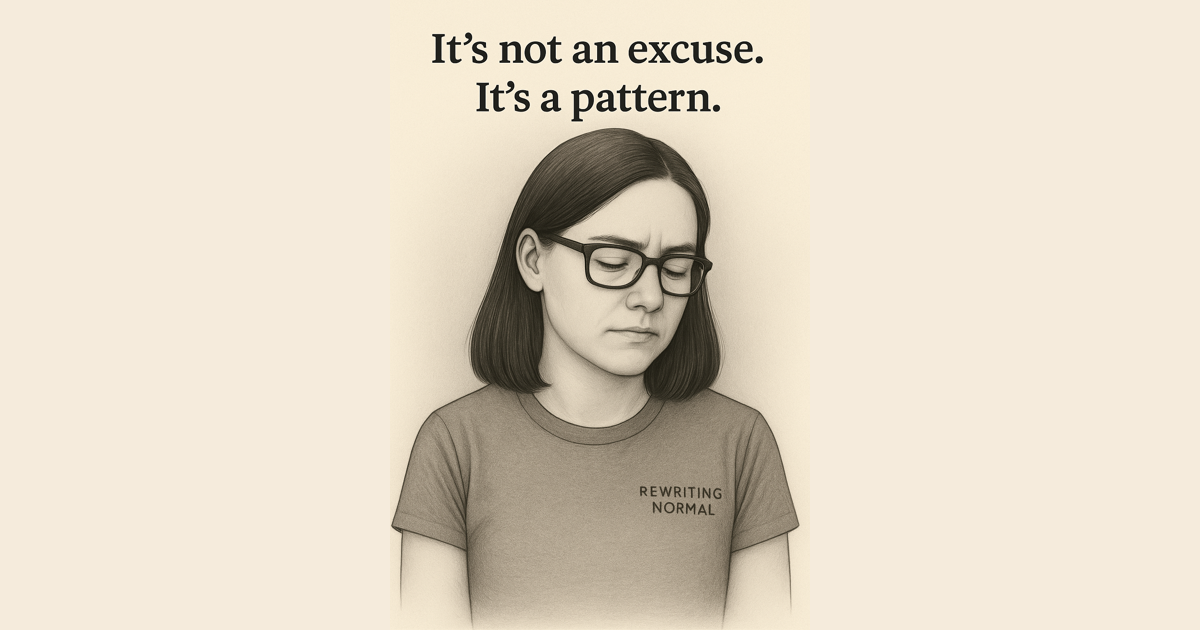
Awareness isn’t an excuse. It’s a framework.
When people say “that’s not an excuse,” it often sounds like they want to shut the conversation down, to decide the behaviour was wrong and move on.
But if we stop at right or wrong, we miss the pattern.
And if we miss the pattern, we don’t learn anything, not about ourselves, not about the people we love, and definitely not about what support might actually help.
And for children? The phrase becomes even more unfair.
Sometimes kids with ADHD don’t know why they did something.
They’re not lying and they’re not dodging. They’re trying to make sense of a moment they didn’t feel in control of.
If a child is antagonising for dopamine, or melting down from a sensory load they can’t name, or locked in a shame loop before anyone even speaks, saying “that’s not an excuse” does nothing but add fear and confusion.
We can still teach boundaries.
We can still support growth.
But we have to do it with curiosity and compassion, not conditional acceptance.
The most responsible thing we can do?
Sometimes it’s not asking:
🛑 “Was that acceptable?”
But instead:
🧠 “What’s the pattern here? And what’s the need?”
Because ADHD isn’t a pass.
It’s a reality.
And it deserves more than a slogan.
🎁 New Freebie: “Patterns, Not Excuses”
A short guide for supporting ADHD kids with accountability + compassion
Kids with ADHD don’t need excuses, they need understanding, structure, and support.
This printable guide helps you replace common shame-based phrases with language that builds reflection, repair, and emotional safety.
✅ Plain-English rephrasing
✅ One-page quick reference
✅ Ideal for parents, teachers, and carers
🧠 Because ADHD doesn’t excuse behaviour, it explains it.
And when we understand the pattern, we can respond with clarity instead of shame.
Find out Why I’m Rewriting Normal